A good fence offers more than just a boundary; it offers peace of mind. It represents the freedom to let your dog play safely in the yard, knowing they are secure from roaming and protected from outside dangers. It transforms your yard into a true sanctuary for your entire family, both human and canine.
But the search for the perfect enclosure can be overwhelming. Finding the right balance between security, style, and budget is a major decision, and it all starts with knowing the best types of fencing for a dog-friendly yard. You need a solution that’s strong enough for an athletic dog, durable enough for the weather, and beautiful enough for your home.
This guide will break down the honest pros, cons, and costs for the top 5 options. Our goal is to arm you with the knowledge you need to make a confident and informed decision for your home and your best friend.
Before You Choose: 5 Key Factors for a Dog-Proof Fence
The “best” fence is different for every dog and every home. Before you fall in love with a particular style, it’s critical to evaluate your specific needs. In fact, considering these five factors first will save you time, money, and potential frustration down the road.
1. Your Dog’s Personality: Jumper, Digger, or Climber?
The most important factor is your dog itself. Their breed, size, and unique personality will dictate the functional requirements of your fence.
- The Jumper: Breeds like Huskies, German Shepherds, and Border Collies are incredible athletes who can easily clear a standard 4-foot fence. For these dogs, a height of at least 6 feet is non-negotiable. Some owners even add extensions or coyote rollers to the top for maximum security.
- The Digger: Terriers, Beagles, and Dachshunds were bred to go underground. A simple fence panel won’t stop them. To counter this, your fence must have a buried base. You can do this by burying chicken wire in an “L” shape at the bottom of the fence line or by pouring a concrete footer. For more tips on this specific issue, our guide, “7 Humane Ways to Stop Your Dog from Digging Up Flower Beds,” offers great behavioral solutions.
- The Climber: Some dogs, especially those with nimble paws, can treat a chain link fence like a ladder. If you have a known climber, a solid privacy fence (like wood or vinyl) with a smooth surface is a much safer option.
- The Small Dog: For small breeds or puppies, the biggest danger is squeezing through gaps. Therefore, the space between pickets or slats is just as important as the height.
2. Height and Gap Safety
Beyond your dog’s specific escape tactics, there are general safety rules for height and gaps.
- Height Guide: A 4-foot fence is often sufficient for small to medium-sized, low-energy dogs. However, a 6-foot fence is the gold standard for most medium to large breeds and provides the best all-around security and peace of mind.
- Gap Guide: The space between vertical pickets on a fence (like aluminum or some wood styles) should be no more than 4 inches. Ideally, for puppies or very small toy breeds, a gap of 2-3 inches is even safer to prevent them from getting their head stuck.
3. Durability and Maintenance Needs
A fence is a long-term investment. Consider how much time and money you are willing to spend on upkeep over the next 10-20 years.
- High Maintenance: Wood fencing requires the most work. It needs to be stained or sealed every few years to prevent rot, warping, and insect damage.
- Low Maintenance: Vinyl and aluminum are the champions of low maintenance. They require virtually no upkeep beyond an occasional wash-down with a hose and some soapy water to remove dirt and mildew.
- Medium Maintenance: Modern, vinyl-coated chain link is very durable. However, if the coating gets damaged, the underlying metal can eventually rust. Composite fencing is low maintenance but may require specific cleaners to deal with mold or mildew in damp climates.
4. Your Budget and Installation (DIY vs. Professional)
Fencing costs can vary dramatically based on material and labor. It’s important to set a realistic budget from the start.
- Cost Ranking (Lowest to Highest):
- Chain Link
- Wood
- Vinyl
- Composite
- Aluminum/Wrought Iron
- Installation: Consider the cost of professional installation versus a DIY project. Wood and some chain link fences can be a manageable DIY project for a handy homeowner, which can save thousands of dollars. In contrast, vinyl and aluminum fences often require specialized tools and precision, making professional installation the recommended route for a perfect, long-lasting result. Always get multiple quotes from professional installers.
5. Local Rules and HOA Regulations
This is a critical but often overlooked step. Before you spend a single dollar, you must check for any local restrictions.
- Your Action: Visit your city or county’s planning department website or call them directly. They will have specific rules about maximum fence height, how far a fence must be set back from your property line, and what materials are permitted. Additionally, if you live in a community with a Homeowners Association (HOA), you must get a copy of its regulations. Many HOAs have very strict rules about fence styles and colors. Getting approval before you build will prevent a costly order to tear your new fence down. A great place to start is by checking with your local building code authority
Comparing the 5 Best Dog Fence Options
Now that you’ve assessed your specific needs, let’s dive into the detailed pros and cons of the five best and most popular types of fencing for a dog-friendly yard.
1. Wood Privacy Fence (The Classic All-Rounder)
![A classic wood privacy fence providing a secure and private dog-friendly yard.]](https://lifes101.com/wp-content/uploads/2025/09/A-classic-wood-privacy-fence.webp)
- Description: A timeless and incredibly popular choice, the wood privacy fence offers an excellent combination of security, seclusion, and natural beauty. It creates a solid visual barrier, which is a major benefit for dogs that are visually reactive and tend to bark at passersby, other dogs, or cars. Common wood choices include pressure-treated pine (most affordable), cedar (naturally rot-resistant), and redwood (premium and durable).
- Pros: First, the privacy it offers is unmatched, creating a true sanctuary in your backyard. Furthermore, the solid barrier can significantly reduce barking triggers for reactive dogs. A wood fence is also aesthetically pleasing and can be stained or painted to perfectly match your home’s style. Finally, it’s one of the more DIY-friendly options for those looking to save on labor costs.
- Cons: However, wood requires the most maintenance. It needs to be cleaned and re-stained or sealed every 2-4 years to prevent rot and weather damage. Additionally, some determined dogs may chew or scratch at the wooden boards. Of course, it also completely obstructs your view, which may not be desirable in all settings.
- Best For: Owners seeking maximum privacy, those with reactive or bark-prone dogs, and handy homeowners who are comfortable with the long-term maintenance commitment.
2. Chain Link Fence (The Durable & Affordable Option)
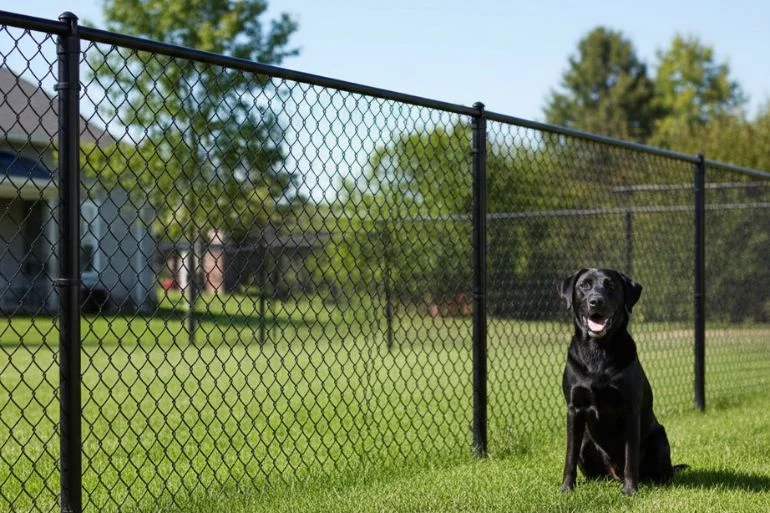
- Description: Often dismissed for its industrial look, modern chain link is one of the most durable, effective, and cost-effective solutions for securing a yard. Forget the old, rusty fences of the past. Today, vinyl-coated options in black or green offer a much more attractive and rust-resistant finish that blends surprisingly well into the landscape. According to the Chain Link Fence Manufacturers Institute, modern fences offer excellent security and longevity.
- Pros: Most importantly, chain link is extremely durable and can last for decades with virtually no maintenance. It’s also one of the most affordable fencing materials, making it a great choice for securing very large yards. Plus, it provides excellent visibility, allowing you to see out and your dog to see their surroundings, which can reduce barrier frustration in some dogs.
- Cons: The biggest drawback is the complete lack of privacy. Also, as mentioned before, the mesh can act as a ladder for athletic or determined dogs who are prone to climbing. The basic look, even when coated, may not suit all home styles.
- Best For: Budget-conscious owners, securing large or irregularly shaped yards, and for dogs that are not prone to climbing or barrier reactivity.
3. Vinyl (PVC) Fence (The Low-Maintenance Beauty)
![A white vinyl privacy fence, a beautiful and low-maintenance choice for a dog-friendly yard.]](https://lifes101.com/wp-content/uploads/2025/09/A-white-vinyl-privacy-fence.webp)
- Description: For homeowners who love the classic look of a painted wood fence but hate the thought of yearly scraping, sanding, and staining, vinyl is a fantastic, long-lasting alternative. Made from durable PVC (polyvinyl chloride), it’s designed to withstand the elements for decades without rotting, warping, or being damaged by insects.
- Pros: The primary benefit is its extremely low-maintenance nature; it just needs an occasional wash-down with a hose. It won’t rot or splinter, which is safer for your dog. Additionally, it comes in a huge variety of styles, from full privacy to classic picket, and in several colors.
- Cons: Vinyl has a higher upfront cost than wood. Also, it can become brittle and crack in extremely cold climates or upon a heavy impact (like from a falling branch or a lawnmower). Repairs can also be more complex than simply replacing a single wooden board.
- Best For: Owners who are willing to invest more upfront for a beautiful fence with “set it and forget it” minimal maintenance for years to come.
4. Aluminum or Wrought Iron (The Elegant & Secure Choice)
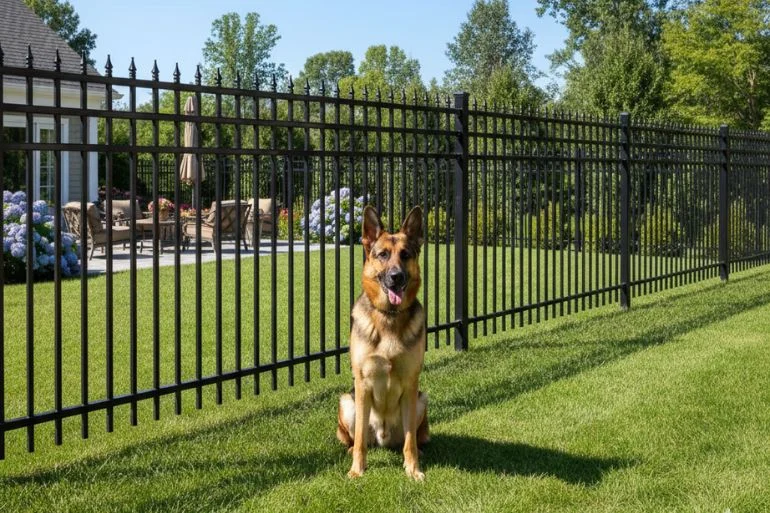
- Description: Offering unparalleled elegance and strength, metal fences like modern aluminum or traditional wrought iron provide excellent security without blocking your view. They are a premium option that can significantly enhance a property’s curb appeal and perceived value. Aluminum is the more popular choice today as it provides the look of wrought iron without the risk of rust.
- Pros: These fences are extremely durable and can last a lifetime with almost no maintenance. They are very secure and virtually impossible for a dog to chew through or climb. Furthermore, their open design provides excellent visibility and a high-end, classic look.
- Cons: This is typically the most expensive fencing option. Most importantly, it provides zero privacy. The biggest safety consideration is the gap width between the pickets; you must ensure it is narrow enough that your dog, or their head, cannot squeeze through.
- Best For: Securing front yards or pool areas where aesthetics are a top priority, for containing dogs that are not small enough to slip through the gaps, and for homeowners who prioritize security and elegance over privacy.
5. Composite Fencing (The Modern, Eco-Friendly Hybrid)
![A modern composite fence, an eco-friendly and low-maintenance alternative to wood for a dog fence.]](https://lifes101.com/wp-content/uploads/2025/09/Gemini_Generated_Image_b3f1tzb3f1tzb3f1-e1757974057983.webp)
- Description: A newer innovation in the market, composite fencing combines recycled wood fibers and plastic polymers to create a durable, long-lasting material. Essentially, this process creates a board that mimics the rich, textured look of real wood without the associated high maintenance of sealing and staining.
- Pros: You get the beautiful aesthetic of wood with the low-maintenance benefits of a synthetic material like vinyl. It is resistant to rot and insects and won’t splinter, which is a great safety feature. Additionally, it is often made from recycled materials, making it an eco-friendly choice.
- Cons: Composite fencing has a high upfront cost, often comparable to vinyl or even aluminum. Also, as a newer technology, it has less of a long-term track record than other materials. The surface can also be susceptible to scratching from a dog’s claws.
- Best For: Eco-conscious owners who want the aesthetic of natural wood but demand the durability and low-maintenance lifestyle of a synthetic material.
Don’t Forget the Gate! (A Critical Safety Detail)
Your fence is only as secure as its weakest point, which is almost always the gate. A flimsy or poorly latched gate is an open invitation for an escape. When planning your fence, invest in a high-quality, solid gate. Most importantly, pay close attention to the latch. The best latches for dog owners are self-latching, meaning they close securely behind you automatically. Furthermore, the opening mechanism should be high enough or complex enough that a clever dog can’t nudge or paw it open.
A Great Fence is Only Part of the Picture
Choosing and installing the right fence is the single biggest step you can take toward creating a safe and secure yard for your dog. However, a truly great dog-friendly space also considers the environment inside those new borders. The layout of your garden, the durability of your lawn, the safety of your plants, and the pathways you create all play a role in creating a harmonious paradise for you and your pet.
Once your fence is up, your next step is to plan the interior. To learn how to create a beautiful and functional space with durable paths, dedicated play zones, and safe plants, read our ultimate guide on how to design a garden layout that your dog won’t destroy.
Conclusion
As we’ve seen, the “best” fence truly depends on your dog’s breed and behavior, your long-term maintenance goals, your home’s aesthetic, and your budget. Therefore, there is no single right answer, but there is a perfect fence for your specific situation. From the classic appeal of wood to the maintenance-free lifestyle of vinyl, the options are plentiful.
Ultimately, you are now equipped with the detailed knowledge to compare the best types of fencing for a dog-friendly yard. By thoughtfully balancing your dog’s safety needs with your home’s style, you can confidently invest in a fence that will provide security, beauty, and most importantly, peace of mind for many years to come.